Cupping Therapy Intake & Consent: Professionally Structured Forms Explained
Discover why cupping therapy requires its own professionally structured intake and consent forms — and what those documents need to cover to protect your clients and your practice.
MASSAGE THERAPY
4/28/20265 min read
If you've added cupping therapy to your practice — or you're planning to — you already know this modality is different from a standard massage session. The technique is different. The client experience is different. The potential for skin marking and post-session reactions is different.
And your intake and consent documentation needs to reflect that.
Generic massage intake forms weren't built for cupping. A standard health history form that asks about medications and preferred pressure doesn't come close to covering what you need documented before you put a single cup on a client's back. That gap is a problem — and it's exactly why cupping-specific forms matter.
In this post, we're breaking down what professionally structured cupping intake and consent forms actually look like, what they need to contain, and why having the right documentation in place protects your clients and your practice.
Why Standard Intake Forms Fall Short for Cupping
Most intake forms in circulation were designed with Swedish or deep tissue massage in mind. They cover the basics: health history, areas of concern, pregnancy status, medication use. That's a reasonable starting point for general bodywork.
Cupping therapy introduces a different set of variables.
Skin markings — commonly called "cupping marks" — are a normal result of the technique. But clients who haven't been properly informed sometimes mistake them for bruising and become alarmed, or worse, feel like something went wrong. Contraindications for cupping are also different from standard massage contraindications. Conditions like varicose veins, active inflammation, skin disorders, bleeding disorders, and certain medications all require careful documentation before you proceed.
If your intake form doesn't address any of this, you're relying on verbal communication alone to cover the gaps. That's not a documentation strategy — that's a liability.
A cupping-specific intake form ensures the conversation happens on paper, before the session starts.
What a Professionally Structured Cupping Intake Form Covers
A well-built cupping intake form does more than ask a few extra questions. It's structured to walk the client through the information you need in a logical, easy-to-complete format. Here's what it should address:
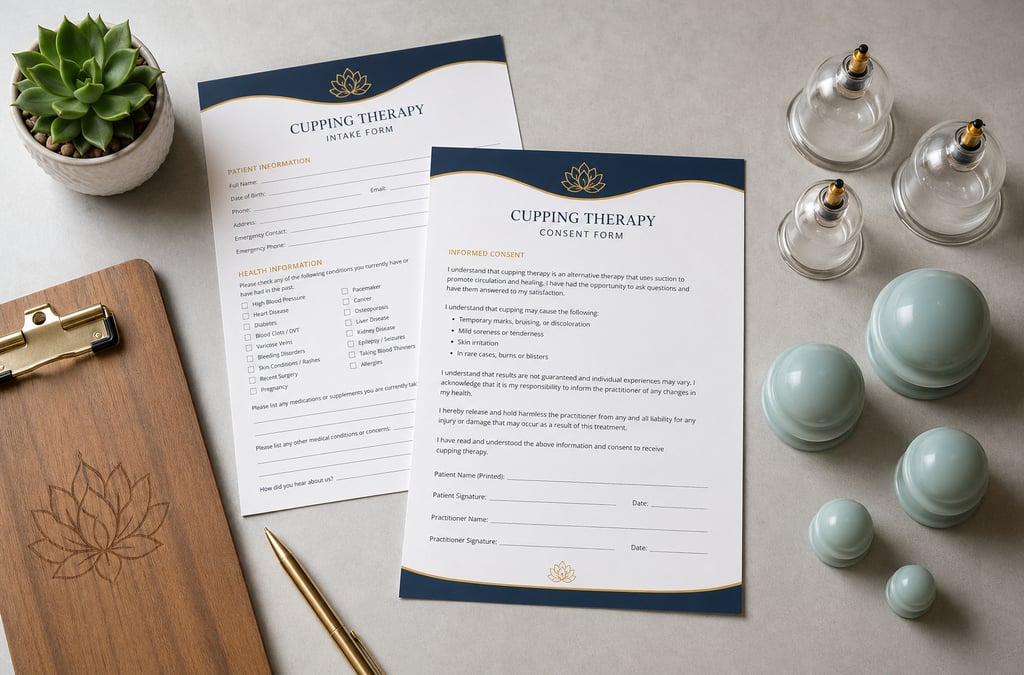
General health history. This includes current medications, medical conditions, surgeries, and anything else that might affect your session planning. This section should capture enough detail to flag issues before they become problems at the table.
Cupping-specific contraindications. This is where a general intake form falls apart. A cupping intake needs a dedicated section covering contraindications specific to this technique — things like active skin conditions, recent sunburn, varicose veins, bleeding disorders, anticoagulant medications, and areas of recent injury or surgery. These aren't covered in a standard form, and they matter.
Preferred session focus and problem areas. Understanding why a client is seeking cupping — whether it's for muscle recovery, respiratory support, fascial release, or general wellness — helps you structure the session and set appropriate expectations.
Prior cupping experience. Knowing whether your client has had cupping before informs how you approach the session. A first-timer needs more education and a different level of communication than someone who's had cupping regularly.
Skin sensitivity and tolerance. Some clients bruise more easily than others. A well-designed form asks about skin sensitivity, gives clients an opportunity to note any concerns, and sets the stage for a conversation about what marks to expect.
What a Cupping Consent Form Actually Needs to Say
Consent forms for cupping therapy serve a very specific purpose: they document that your client understood what they were agreeing to before the session began. That's different from just having them sign something.
A professionally structured cupping consent form should clearly explain:
The nature of the technique. The client should understand they are receiving a technique that uses suction on the skin and soft tissue. Plain language matters here. Overly clinical phrasing doesn't serve your clients or your practice.
Expected and possible outcomes. Cupping marks are a normal result of the therapy, not a sign of injury. Your consent form should explain this clearly — what marks look like, how long they typically last, and that individual responses vary. Clients who are surprised by marks after a session are clients who weren't properly informed.
Known risks and contraindications. Even with a thorough intake, your consent form should document that the client was informed of the potential risks — including temporary skin marking, bruising, mild soreness, or in rare cases, blistering from excessive heat or suction.
Client acknowledgment and agreement. This is the portion where the client confirms they've read the form, that their health information is accurate to the best of their knowledge, and that they are voluntarily choosing to receive the service. A signature line with a date field is standard here.
A consent form that just says "I agree to receive massage" and asks for a signature isn't a cupping consent form. It's a piece of paper that doesn't protect you or your client.
How These Forms Work Together
The intake and the consent form are two separate documents, and they serve two separate functions — but they work as a system.
The intake form gives you the clinical picture. It tells you what you're working with before you design the session.
The consent form documents that the client was informed and agreed to proceed. It's the record that protects both parties if questions ever come up later.
Having both in place, completed before every session with a new cupping client, is the professional standard. It also signals something to your clients: that you take this modality seriously and that you run a thorough, professional practice. That impression matters, especially when clients are trying cupping for the first time and may already have some hesitation.
The Problem with Building These from Scratch
If you've ever tried to build these forms yourself, you know how quickly it becomes a time sink. You draft the intake questions. You rewrite the consent language. You worry about whether you've covered everything. You tweak the layout so it doesn't look like a homework assignment.
And then you're still not sure if you got it right.
That's the real reason professionally structured, ready-to-use forms exist. They're built with the specific requirements of cupping therapy already baked in — the contraindication checklists, the consent language, the client acknowledgment sections. You print them, use them, and trust that the foundation is solid.
Our Cupping Therapy Client Bundle includes the intake and consent forms described in this post, along with the additional documentation you need to run a complete cupping practice: treatment tracking, post-session care instructions, and client communication tools. Everything is a static PDF — professionally formatted, ready to print, and built to be completed by hand.
No software required. No subscriptions. Buy it once, print unlimited copies.
If cupping is part of your practice, your documentation should be built for cupping. That's what these forms are.
FormSolutionsPro.com creates professionally structured PDF forms for massage therapists and wellness practitioners. Our forms are static PDFs — designed to be printed, completed by hand, and filed. They are intended for informational and administrative use and do not constitute legal or medical advice.
© 2025. Form Solutions Pro - All rights reserved.