
Deep Tissue Massage Client Forms: Setting Professional Standards from Day One
A look at why generic intake forms fall short for deep tissue work — and what modality-specific documentation should actually cover to protect your clients and your practice.
MASSAGE THERAPY
5/26/20266 min read
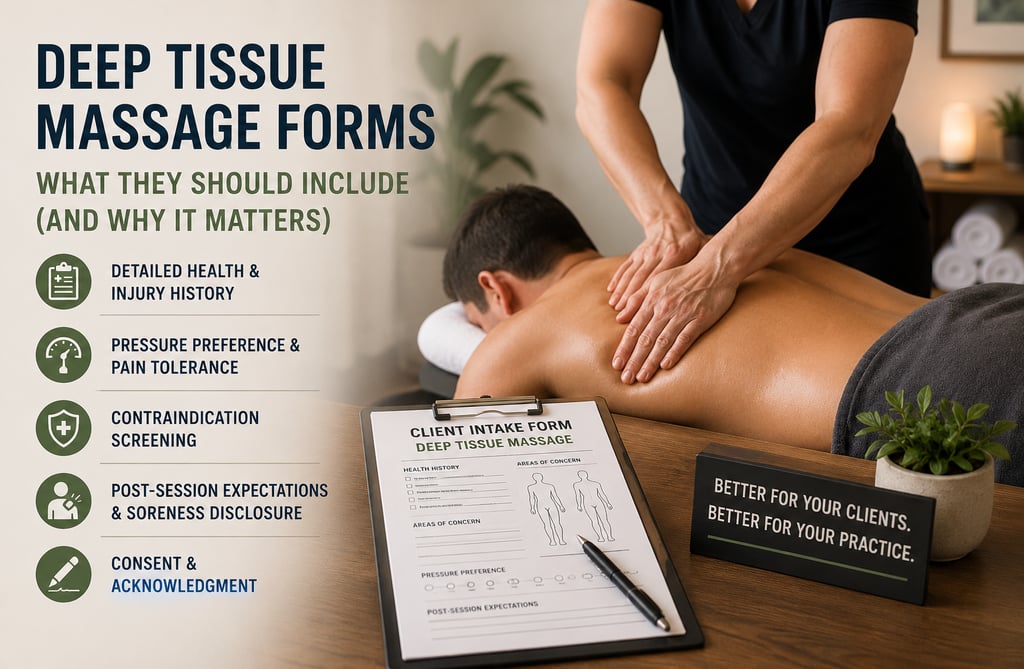
When a client books a deep tissue session, they're not looking for a relaxation massage. They're coming in with a specific issue — chronic tension, a nagging injury, limited range of motion — and they expect you to work with purpose. The pressure is higher. The technique is more targeted. And the potential for post-session soreness, discomfort during the session, and contraindication concerns is significantly different from a standard Swedish appointment.
Your client documentation should reflect that difference.
The problem is, most massage therapists are still using the same generic intake form for every modality they offer. A form that asks about "areas of concern" and "preferred pressure" might be fine for a relaxation client, but it doesn't come close to covering what needs to be documented before a deep tissue session. That gap creates risk — for your clients and for your practice.
In this post, we're breaking down what deep tissue massage client forms should actually include, why they need to go beyond generic templates, and how having the right documentation in place sets a professional standard that protects everyone involved.
The Problem with Using Generic Forms for Deep Tissue Work
Here's the reality: most intake forms circulating online were designed with general relaxation massage in mind. They check a few boxes — health history, allergies, pregnancy status, maybe a body diagram where the client circles their trouble spots. That's a solid foundation for a basic session.
Deep tissue work introduces a completely different set of considerations.
The pressure levels involved are substantially higher than a relaxation session. Clients may have existing injuries, inflammation, or conditions that could be aggravated by intensive work on specific muscle groups. Post-session soreness is expected and normal — but if the client wasn't informed beforehand, that soreness can turn into a complaint, a negative review, or worse, a dispute about what was agreed upon.
A generic form doesn't capture any of that. And when something isn't documented, it's as if the conversation never happened.
What Deep Tissue-Specific Intake Forms Should Cover
A well-structured deep tissue intake form goes beyond the basics and addresses the specific variables that come with this modality. Here's what that looks like in practice.
Detailed Injury and Condition History
Deep tissue work frequently targets problem areas — chronic pain, old injuries, repetitive strain, post-surgical recovery. Your intake form needs to ask about these with more specificity than a generic health questionnaire provides. That means documenting not just "Do you have any injuries?" but the location, duration, severity, and whether the client is currently under a physician's care for the condition.
This level of detail helps you plan the session appropriately and gives you a written record of what the client disclosed before treatment began. Both of those things matter if questions ever come up later.
Pressure Preference and Pain Tolerance Assessment
"Medium to firm" isn't a useful data point when you're doing deep tissue work. A structured pressure preference section should give the client a clear scale — typically ranging from light to very firm — and ask specifically about their comfort with deep pressure on different body regions.
Some clients want intense work on their shoulders but can't tolerate the same level on their lower back. A form that captures those regional preferences helps you deliver a more effective session and proves you asked before applying pressure.
Contraindication Screening Specific to Deep Tissue
Every massage modality has contraindications, but deep tissue carries some that don't apply to lighter work. Blood clotting disorders, recent surgeries, acute inflammation, certain cardiovascular conditions, and areas with compromised skin integrity all require specific screening before deep pressure is applied.
A generic contraindication checklist that covers "general massage" won't flag these deep tissue-specific concerns. And when a contraindication goes unscreened, you're taking on risk that could have been avoided with a better form. Purpose-built forms ask the right questions so nothing gets missed.
Post-Session Expectations and Soreness Disclosure
This is the section most generic forms skip entirely — and it's one of the most important for deep tissue work.
Clients who are new to deep tissue massage are often surprised by post-session soreness. When a client experiences unexpected discomfort the day after their appointment, the natural reaction is to assume something went wrong. But if you've documented that you informed them about normal soreness, recommended hydration, and explained what to expect during the recovery period, you've established a clear record that proper communication happened.
That documentation protects you from misunderstandings and demonstrates professionalism from the very first appointment.
Consent and Acknowledgment
Beyond the standard consent language that every massage form should include, deep tissue-specific consent addresses the unique aspects of this modality. The client acknowledges that they understand the technique involves firm to deep pressure, that post-session soreness is a normal response, and that they've been advised to communicate during the session if the pressure becomes uncomfortable.
This isn't about creating a legal fortress around your practice — it's about making sure the client understands what they're signing up for, and that you have documentation showing you communicated clearly.
Why This Matters on Day One
The temptation for a lot of therapists — especially when they're just starting out or adding deep tissue to their service menu — is to figure out the documentation later. Start seeing clients now, dial in the paperwork when things settle down.
That approach works right up until it doesn't.
All it takes is one client who experiences unexpected soreness and can't remember whether you discussed it. One insurance question about a pre-existing condition that wasn't documented. One misunderstanding about pressure expectations that escalates into a formal complaint.
When you have professionally structured forms in place from the very first client, those situations don't escalate. The documentation speaks for itself. You have a signed record of the health disclosure, the pressure discussion, the soreness expectations — all captured before the session started.
That's not just good practice. That's the standard clients are starting to expect when they walk into a professional massage practice.
Building Your Deep Tissue Documentation System
Individual forms are the building blocks, but a complete documentation system ties everything together. For deep tissue work, that system typically includes:
An intake form with deep tissue-specific health screening and injury history. A consent form that addresses pressure levels, post-session expectations, and modality-specific risks. A session notes template where you can document what was addressed, the pressure applied, and the client's response. And a cancellation or policy agreement so your business terms are documented alongside the clinical paperwork.
Each of these forms serves a distinct purpose, and together they create a documentation trail that covers the full client experience — from the moment they fill out their paperwork to the notes you write after the session ends.
When all of those pieces are in place, you're not just handing clients a clipboard and hoping for the best. You're running a practice that looks and feels professional from the moment they walk through the door.
Setting the Standard, Not Playing Catch-Up
The therapists who invest in proper documentation early are the ones who never have to scramble to fix a paperwork problem later. They don't have to retroactively get consent signatures. They don't have to reconstruct a health history from memory. They don't have to explain to a client — or an insurance company — why something wasn't documented.
Deep tissue massage is a modality that demands precision in technique. Your client forms should reflect that same level of precision in documentation.
If you're currently using one general intake form for every service you offer, it might be time to take a closer look at whether that form actually covers the specific needs of your deep tissue clients. Chances are, there are gaps — and those gaps are easier to fill now than after a problem surfaces.
Looking for professionally structured deep tissue massage forms? Browse our complete collection of modality-specific forms at FormSolutionsPro.com/forms — designed specifically for massage therapists who want documentation that matches the quality of their work.
Want a quick-reference checklist of the essential forms every massage practice needs? Download our free 31 Essential Forms Checklist at FormSolutionsPro.com/free-checklist — it takes 30 seconds and helps you identify exactly where your current documentation might have gaps.
The information in this article is provided for educational and informational purposes only. FormSolutionsPro.com is not a law firm and does not provide legal or medical advice. Form templates are professional business tools — practitioners are responsible for ensuring their documentation practices comply with applicable laws and professional standards in their jurisdiction.
© 2025. Form Solutions Pro - All rights reserved.