
How to Create Professional SOAP Notes for Massage Therapy That Transform Your Practice
Struggling to document massage sessions properly? Discover how to create professional SOAP notes for massage therapy that protect your practice, satisfy insurance requirements, and transform vague session notes into legally defensible clinical documentation—without spending hours writing.
MASSAGE THERAPY
12/17/20256 min read
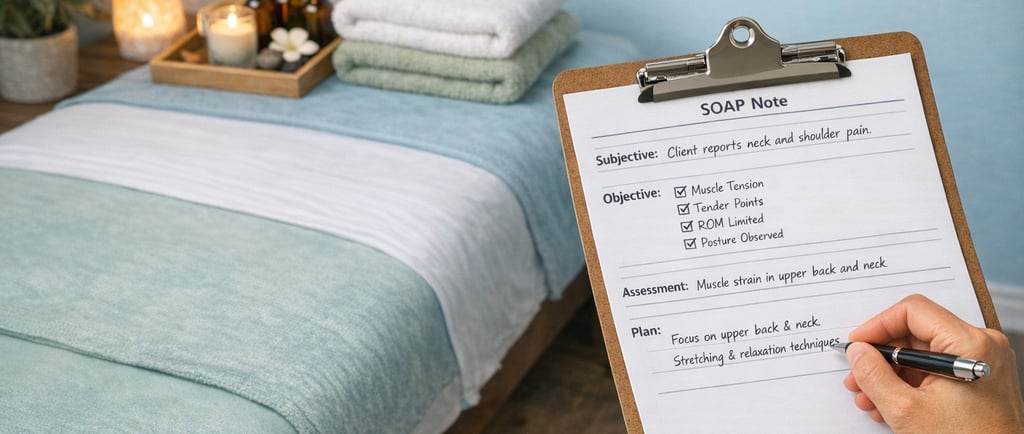
The moment a client walks off your table feeling like a new person, you face a harsh reality: documenting that session feels like homework after a beautiful concert. You know what happened. Your hands remember every adhesion, every trigger point, every moment of release. But translating that tactile story into coherent clinical notes? That's where most therapists stumble, leaving gaps that could haunt them years later during an insurance audit or legal inquiry.
Bodyworkers with gifted hands freeze up when it's time to document their work. They'll spend ninety minutes performing transformative therapy, then rush through documentation in three minutes flat—scribbling cryptic abbreviations that even they can't decipher a week later. This disconnect doesn't just create liability risks. It undermines the very professionalism that separates legitimate therapeutic practice from a simple relaxation service. Every incomplete note is a missed opportunity to demonstrate clinical reasoning, track treatment progression, and build an airtight paper trail that protects both you and your clients.
Here's what most massage therapy programs won't tell you: documentation is where your clinical expertise becomes legally defensible. The transformation that happens on your table means nothing if you can't articulate it in writing.
The Hidden Architecture Behind Clinical Documentation
Most therapists think SOAP notes are just administrative boxes to check. They're actually sophisticated storytelling frameworks that translate your clinical thinking into a universally understood language. The acronym breaks down into Subjective, Objective, Assessment, and Plan—but that surface-level understanding misses the strategic depth beneath each section.
The Subjective Section: Capturing the Client's Voice
The Subjective section isn't just "client said shoulder hurts." It's your opportunity to establish medical necessity through the client's own words. When you document "Client reports sharp, stabbing pain in right shoulder (8/10 intensity) that radiates down the arm when reaching overhead, particularly during work tasks requiring computer use," you're building a case for therapeutic intervention that insurance companies and legal reviewers can't dismiss.
What to capture in your Subjective notes:
Pain quality and intensity - Use the client's exact descriptors (sharp, dull, burning, aching) plus numeric pain scale ratings
Location and radiation patterns - Document precisely where pain originates and where it travels
Aggravating and relieving factors - What makes it worse? What brings relief?
Functional limitations - How does this affect daily activities, work, sleep, or recreation?
Onset and duration - When did symptoms begin? Are they constant or intermittent?
Previous treatment history - What else has the client tried? What worked or didn't work?
Here's where therapists lose credibility: they bury gold in vague language. "Client has tension" means nothing. "Client presents with bilateral upper trapezius hypertonicity, decreased cervical ROM (rotation limited to 60 degrees bilaterally), and forward head posture of approximately 2 inches" tells a complete clinical story. This level of specificity isn't showing off—it's demonstrating that you actually assessed the condition rather than just working where it "felt tight."
The Objective Section: Where Your Hands Become Data
Your objective findings should read like a detailed map of tissue dysfunction. Temperature changes, tissue texture variations, restricted joint mobility, postural deviations, gait abnormalities—these aren't optional extras. They're the foundation of your clinical reasoning.
Document What Your Assessment Reveals
Essential objective measurements to include:
Postural observations - Head position, shoulder height, pelvic alignment, spinal curves
Range of motion - Use goniometer measurements or comparative assessments (limited, normal, hypermobile)
Palpation findings - Tissue temperature, texture, tonicity, tenderness, trigger points
Functional tests - Orthopedic assessments, strength testing, gait analysis
Visual observations - Skin condition, swelling, bruising, surgical scars
The transformation happens when you connect objective findings to functional outcomes. Instead of "worked on lower back," try "addressed bilateral lumbar paraspinal hypertonicity with decreased tissue pliability in L3-L5 region; post-treatment palpation revealed improved tissue mobility and client demonstrated improved forward flexion (fingertips to floor increased from 8 inches to 3 inches)." You've just documented measurable improvement that justifies the session and sets up the next treatment.
Pro tip: Most therapists skip the comparative element entirely. They document what they found but never measure change. Your notes should answer the unspoken question every reviewer asks: "Did this treatment actually accomplish anything?" Pre-treatment and post-treatment measurements—whether ROM, pain scale ratings, or functional tests—provide quantifiable proof of therapeutic value.
Assessment: Your Clinical Brain on Paper
This section terrifies therapists because it demands clinical judgment in writing. You're synthesizing subjective complaints and objective findings into a coherent clinical picture. The therapist who writes "Client improving" has documented nothing useful.
Crafting Assessments That Demonstrate Clinical Expertise
The therapist who writes "Client demonstrates 40% reduction in reported pain levels and improved shoulder abduction ROM (increased from 120° to 160°) following three treatments focused on subscapularis and anterior deltoid adhesions; symptoms consistent with rotator cuff impingement pattern showing positive response to soft tissue mobilization" has documented clinical expertise.
Your assessment should address:
Response to treatment - Is the client improving, plateauing, or declining?
Clinical reasoning - Why do you think the symptoms exist? What's the underlying dysfunction?
Contributing factors - Postural habits, occupational demands, previous injuries, stress levels
Treatment effectiveness - Are your interventions producing the desired outcomes?
Barriers to progress - What's preventing faster or fuller recovery?
Your assessment should also identify why symptoms persist if improvement hasn't occurred. "Chronic postural dysfunction from occupational computer use continues to contribute to recurring symptoms despite temporary relief from manual therapy; client would benefit from ergonomic evaluation and corrective exercise program" shows sophisticated clinical thinking that goes beyond massage-table magic.
Here's the insider move: reference previous assessments to show treatment progression. "Compared to initial evaluation on [date], client now reports 60% overall improvement in baseline symptoms and has reduced pain medication use from daily to as-needed" creates a narrative arc that demonstrates your treatment's cumulative impact.
The Plan: Your Roadmap to Continued Care
Generic plans destroy your credibility. "Continue massage therapy" could mean anything. "Continue biweekly 60-minute sessions focusing on myofascial release of thoracic paraspinals and scalenes, progressing to monthly maintenance once client achieves pain-free ROM and can maintain improvements between sessions; reassess in 4 weeks" demonstrates strategic treatment planning.
Building Plans That Guide Treatment Forward
Every plan should include:
Treatment frequency and duration - How often and for how long (with clinical justification)
Specific techniques to employ - Myofascial release, trigger point therapy, Swedish massage, stretching
Target areas and tissues - Which muscles, fascia, or joints you'll address
Measurable goals - What outcomes define success?
Home care recommendations - Stretches, ice/heat protocols, activity modifications
Reassessment timeline - When will you evaluate progress and adjust the plan?
Referrals or collaborations - Other providers who should be involved in care
Sample comprehensive plan: "Continue weekly 90-minute sessions for 4 weeks focusing on: (1) Deep tissue work to bilateral piriformis and hip rotators, (2) Myofascial release along IT band, (3) Gentle joint mobilization of SI joint. Goal: Reduce sciatic pain from 7/10 to 3/10 and restore pain-free walking for 30+ minutes. Home care: ice after activity, piriformis stretch 3x daily, avoid prolonged sitting. Reassess after 4th session; may reduce to biweekly if 50% improvement achieved. Recommended consultation with chiropractor for SI joint evaluation."
The most overlooked element? Timeline for reassessment. Building in checkpoints shows you're monitoring progress and adjusting treatment based on outcomes rather than just booking recurring sessions indefinitely.
Common Documentation Pitfalls That Undermine Your Professionalism
Even experienced therapists fall into these traps that weaken their clinical documentation:
Avoid these mistakes:
Using unclear abbreviations without a legend
Copying and pasting previous notes without updating current findings
Documenting treatment techniques but not outcomes
Failing to note contraindications or modifications made
Omitting client education and self-care instructions
Writing subjective opinions in the objective section
Using judgmental or unprofessional language
Leaving gaps of weeks or months without documentation
Not obtaining or documenting informed consent for treatment modifications
Time-Saving Documentation Strategies That Maintain Quality
I get it—you didn't become a massage therapist to spend hours writing notes. But documentation doesn't have to drain your energy or eat into your personal time.
Efficiency hacks that actually work:
Document immediately after each session while details are fresh (5-7 minutes beats 30 minutes of trying to remember later)
Use templates with prompts to guide your thinking and ensure you don't miss critical elements
Create text shortcuts for commonly used phrases and anatomical terms
Develop a consistent workflow so documentation becomes automatic rather than mentally taxing
Keep reference materials handy for proper terminology and abbreviations
Set up your workspace with everything you need for efficient note-taking
The sweet spot? Most therapists can complete thorough SOAP notes in 5-8 minutes per session once they have a solid system in place. Compare that to the hours you might spend reconstructing notes from memory when a client requests records or an insurance company audits your claims.
Your Documentation System Can Make or Break Your Practice
The difference between thriving practices and struggling ones often comes down to systems. Therapists who maintain meticulous documentation protect themselves legally, command higher insurance reimbursements, and build practices that can scale beyond their personal capacity to work on clients.
Therapists lose insurance contracts because their documentation couldn't justify medical necessity. Practices survive legal challenges specifically because their notes demonstrated informed consent and appropriate clinical reasoning. Your documentation isn't just paperwork—it's the professional infrastructure that supports everything else you do.
Your hands do incredible healing work—your documentation should reflect that same level of professionalism and precision.
Ready to eliminate documentation stress forever? Stop struggling with blank pages and inconsistent formats that leave you second-guessing every word. Discover professionally designed SOAP note templates that guide you through every clinical detail while you focus on what matters—your clients' healing. These aren't generic forms that force you to adapt your practice. They're built by therapists, for therapists, with the exact structure that insurance companies demand and legal professionals respect.
Click here to access proven documentation tools that practicing massage therapists actually use to protect their practice, impress insurance reviewers, and reclaim hours of administrative time. Your future self (and your attorney) will thank you.
© 2025. Form Solutions Pro - All rights reserved.