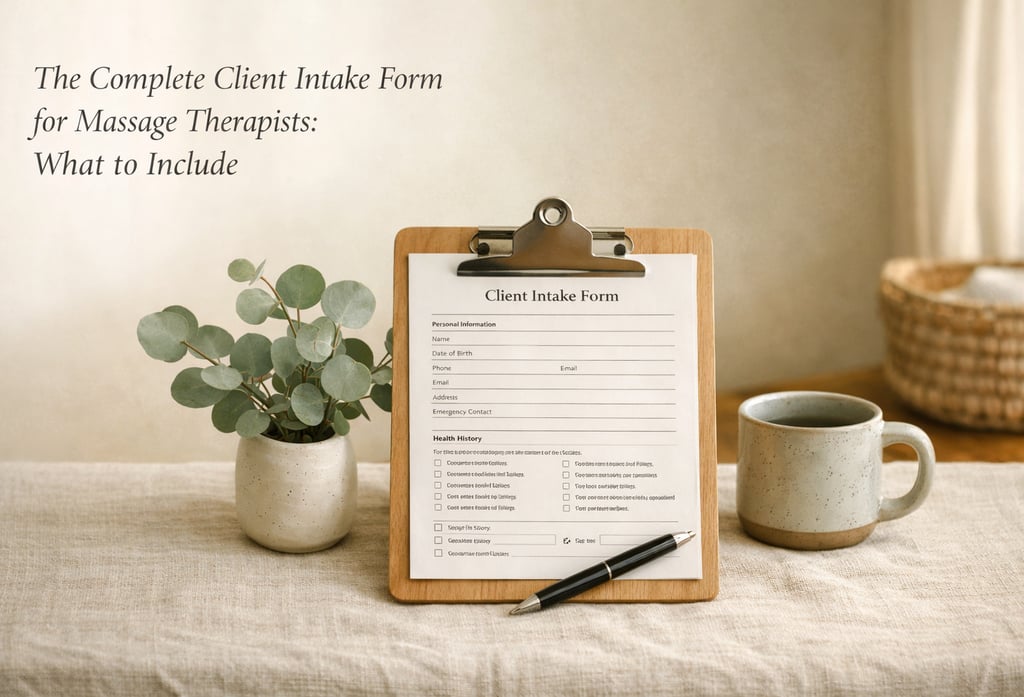
The Complete Client Intake Form for Massage Therapists: What to Include
Build a complete client intake form for massage therapy with this practical guide — protect your practice, impress clients, and document what actually matters.
MASSAGE THERAPY
4/1/20265 min read

Every massage therapist remembers that moment: a new client is on your table, the session is going well — and then they casually mention they're on blood thinners. Or had surgery six months ago. Or they're in their first trimester.
If you asked about it on your intake form, you're prepared. If you didn't, you're improvising.
The complete client intake form for massage therapists isn't just a formality. It's the foundation of a safe, professional client relationship — and it starts before you ever put hands on a client.
When we set out to build FormSolutionsPro, we noticed something: most intake forms out there were built for everyone, which meant they worked well for no one in particular. Too generic to catch real red flags. Too sparse to project real professionalism. We built something better.
This post walks you through exactly what belongs on a complete massage therapy intake form — and what most practitioners leave out.
Why the Wrong Intake Form Costs You More Than You Think
Here's what a weak intake form actually does to your practice.
It leaves you flying blind. You don't know about the client's recent surgery, their chronic condition, or the medication that contraindicates deep pressure work. You adapt on the fly — or worse, you don't adapt at all.
It undermines your professionalism. Clients notice when your paperwork looks like it was typed up in a hurry or downloaded from a generic template site. The forms on your clipboard are often the first physical impression of your practice.
It creates liability exposure. If a client has a reaction or an adverse outcome and your intake form didn't ask the right questions, you have no documentation to show you did your due diligence. That matters.
The most common mistakes practitioners make:
Using the same one-page form for every modality (a sports massage client and a prenatal client have very different needs)
Asking only basic contact info and skipping health history entirely
Relying on verbal intake instead of written documentation
Using outdated forms that don't reflect what they're actually offering in their practice
The fix isn't complicated. It just requires knowing what a complete intake form actually needs to include.
What a Complete Massage Therapy Intake Form Should Include
Let's break this down section by section. A well-built intake form does three things: collects what you need to work safely, documents client consent, and establishes a professional first impression.
Section 1: Client Contact & Basic Information
This is the easy part — but don't skip details.
Full legal name
Date of birth
Phone number and email
Emergency contact (name and relationship)
How they heard about you (useful for your own marketing tracking)
Pro tip: Including date of birth allows you to catch anything age-related that might affect your approach — and it's essential if you ever work with minors or senior clients.
Section 2: Health History
This is where most generic forms fall short. Your health history section needs to be specific enough to actually surface contraindications.
Include questions about:
Current medications (especially blood thinners, anti-inflammatories, muscle relaxants)
Recent surgeries or injuries (within the past 12 months)
Chronic conditions: diabetes, cardiovascular disease, cancer history, autoimmune disorders, osteoporosis
Skin conditions, open wounds, or active infections
Pregnancy status
Areas of pain, sensitivity, or recent trauma
Don't ask yes/no only. Leave room for clients to explain. A checkbox for "heart condition" is less useful than a checkbox plus a line for details.
Section 3: Session Goals & Preferences
This section transforms intake from a screening tool into a client experience tool.
Ask about:
Primary reason for today's visit (relaxation, pain relief, injury recovery, stress management)
Areas to focus on
Areas to avoid
Pressure preference
Any previous massage experience and what they did or didn't like
This is the section that lets clients feel heard before the session starts — and it gives you a roadmap.
Section 4: Informed Consent
Every intake form needs a clear consent section. This doesn't have to be dense legalese — it just needs to be explicit.
Your consent section should cover:
Acknowledgment that massage therapy is not a substitute for medical treatment
Permission to perform the session as discussed
Agreement that the client has disclosed all relevant health information
Your cancellation and rescheduling policy (brief — you can have a separate policy form)
Signature and date line
Keep this section readable. Clients skim walls of text. Bullet it out, use plain language, and make the signature line obvious.
Section 5: SOAP/Session Notes Area (Optional but Recommended)
Some practitioners prefer a combined intake and session notes form. If that works for your workflow, include a brief notes section on the back of the intake form — areas worked, client feedback, therapist observations, and follow-up recommendations.
If you keep these separate, that's fine too. Just make sure your system accounts for both.
📋 Not sure if your current forms cover everything they should? Download our free checklist — 31 Essential Forms Your Massage Practice Needs in 2026 — and find out exactly where your documentation gaps are. Includes a practice compliance score and documentation gap assessment. Get the Free Checklist →
How to Actually Use This Form in Your Practice
Knowing what to include is step one. Building it into your workflow is where it sticks.
When to have clients complete the intake form:
New clients: before their first appointment, ideally sent via email or available on your booking page so they arrive already done
Returning clients: review annually, or any time they mention a new health development
After a gap in visits: anyone who hasn't been in 6+ months should update their intake information
Address the "will this feel intrusive?" concern head-on. Most clients actually appreciate a thorough intake process — it signals that you take their health seriously. A brief verbal cue helps: "I have a short health form I ask all new clients to complete — it helps me personalize your session."
Quick wins you can act on today:
If you're using a form older than two years, review it against the section checklist above
Add an emergency contact field if yours doesn't have one
Make sure your consent language is in plain English and clearly signed
The intake form isn't the most glamorous part of running your practice. But it's often the one that makes clients feel most confident they're in capable hands.
Advanced Tips: What Separates Professional Practices from Amateur Ones
Avoid these common mistakes:
Asking leading questions ("You don't have any health conditions, do you?") instead of open, neutral ones
Making the form so long it feels like a medical exam — aim for thorough, not exhausting
Skipping the review step: collecting the form and never looking at it defeats the purpose
What experienced practitioners do differently:
They review the form before the session, not during. Skimming it in the room while the client watches is unprofessional and defeats the purpose.
They use the session goals section to open the conversation: "I see you're dealing with shoulder tension — let's make sure we prioritize that today."
They update intake records when something changes, not just at the annual review
For specialized modalities — prenatal, oncology, sports — they use forms designed specifically for that work, not adapted general forms. The right questions are very different.
A general intake form is a starting point. A modality-specific form is where real documentation quality lives.
If you'd rather skip the blank page entirely, our Massage Therapy Client Intake Form is available in the FormSolutionsPro store — professionally designed, print-ready, and built to cover exactly what's in this guide.
Your Intake Form Is the First Statement Your Practice Makes
Before the warm towels. Before the music. Before you say a word — the form in your client's hands is already communicating something about you.
A thorough, clearly designed intake form says: this practitioner is organized, professional, and takes my health seriously. A generic or incomplete one says the opposite.
The goal isn't paperwork for its own sake. It's building a practice where every client feels cared for, every session starts with the information you need, and you're protected if something unexpected happens.
Start with the right form. Build the right habits around it. The rest follows.
✅ Know Exactly Which Forms Your Practice Needs
Download our free 31 Essential Forms Your Massage Practice Needs in 2026 checklist and get your practice compliance score.
No fluff — just a clear picture of where you stand and what to do about it.
© 2025. Form Solutions Pro - All rights reserved.