Why Your Massage Practice Needs Specialty Consent Forms (Not Just Generic Ones)
Specialty consent forms do more than protect your practice legally—they educate clients, set clear expectations, and demonstrate your expertise. Discover why modality-specific documentation is the foundation of a professional massage business.
MASSAGE THERAPY
1/7/20265 min read
You've probably got a consent form. Maybe it's the one you grabbed during massage school, or a template you downloaded years ago. It covers the basics: client information, a signature line, maybe a generic health questionnaire.
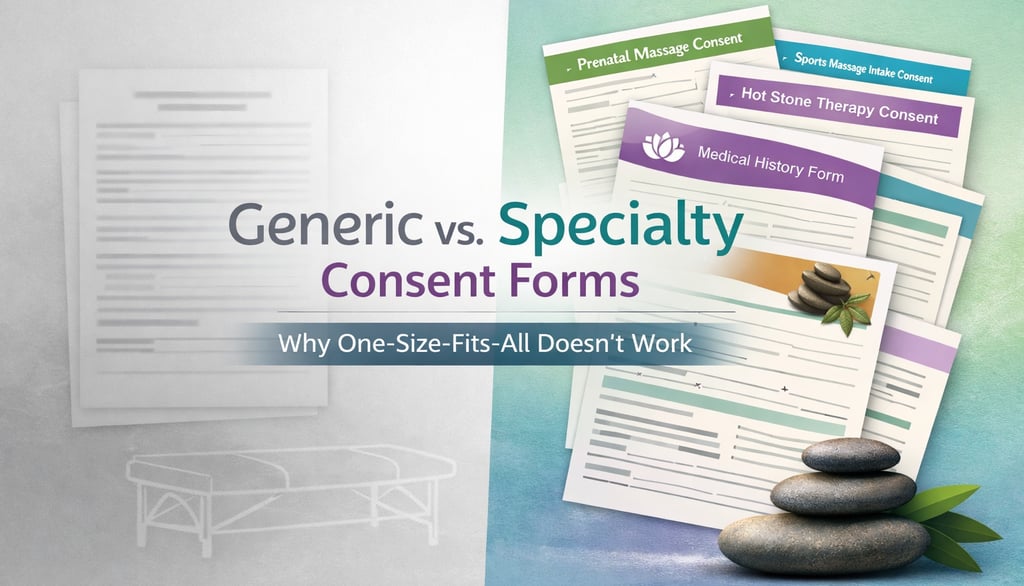
Here's the thing: that one-size-fits-all approach worked fine when you were doing Swedish massage every day. But now you're offering hot stone therapy, prenatal massage, and deep tissue work—and that generic form isn't cutting it anymore.
Let me explain why specialty consent forms aren't just helpful—they're essential for running a professional, legally protected massage practice in 2025.
The Problem With Generic Consent Forms
Generic massage consent forms try to cover everything, which means they don't cover anything particularly well. It's like using a butter knife when you really need a scalpel—technically a tool, but not the right one for the job.
What generic forms typically miss:
Modality-specific risks and contraindications
Detailed health screening for specialized techniques
Clear expectations for each type of treatment
Proper documentation of informed consent for higher-risk modalities
When you're working with pregnant clients, elderly clients, or using techniques like cupping or deep tissue work, you need documentation that speaks directly to those unique situations. A generic form leaves gaps—and those gaps can become liabilities.
The Real Risks of One-Size-Fits-All Documentation
Let's talk about what can happen when you don't have proper specialty forms in place.
Scenario 1: You're doing a hot stone massage. Your generic form asks about temperature sensitivity, but it doesn't specifically document that you explained the heat levels involved, the possibility of burns, or the contraindications for diabetic clients with neuropathy. If something goes wrong, you have no clear record of informed consent.
Scenario 2: You're working with a prenatal client in her third trimester. Your standard form notes she's pregnant, but it doesn't document positioning concerns, trimester-specific risks, or contraindications like preeclampsia or placenta previa.
Scenario 3: A client wants deep tissue work to address chronic pain. Your basic form doesn't distinguish between relaxation massage and therapeutic deep tissue—so you have no documentation of the soreness discussion, the pressure preference, or the understanding that this isn't a "spa day" experience.
See the pattern? Each specialty requires its own conversation, its own risk assessment, and its own documented understanding between you and your client.
Breaking Down the Benefits: Why Specialty Forms Matter
BenefitGeneric FormSpecialty FormLegal ProtectionBasic coverage onlyComprehensive, modality-specific protectionClient CommunicationGeneral informationDetailed expectations for each serviceProfessional ImageStandard approachDemonstrates expertise and attention to detailRisk ManagementOne-level screeningTargeted health questions for each techniqueDocumentation QualitySurface-level recordsDetailed, specific consent trail
Better Client Communication
When you hand a client a specialty consent form, you're doing more than covering legal bases—you're educating them.
A good aromatherapy massage consent form doesn't just ask about allergies. It explains what essential oils you'll use, how they work, potential reactions, and why certain oils are contraindicated for pregnant clients or people with specific conditions.
This upfront education prevents misunderstandings and sets proper expectations. Your clients feel informed and cared for, not just processed.
Enhanced Legal Protection
Let's be honest: we live in a litigious world. Even the best therapists can face complaints or legal issues—not because they did anything wrong, but because expectations weren't clear or documentation was lacking.
Specialty forms provide specific, detailed documentation that shows:
You asked the right questions for that particular modality
You explained the unique risks involved
The client understood and consented to those specific risks
You took appropriate precautions based on their responses
This specificity matters enormously if you ever face a licensing board inquiry or legal challenge.
Key Modalities That Need Their Own Forms
Not every massage technique requires a separate form, but these definitely do:
Prenatal Massage
Pregnancy massage involves unique positioning, trimester-specific risks, and contraindications that don't apply to regular massage. You need to document:
Current trimester and due date
Pregnancy complications (preeclampsia, gestational diabetes, etc.)
Previous pregnancy losses or complications
Positioning preferences and restrictions
Understanding of when massage is contraindicated
Check out professionally designed prenatal massage consent form that cover all these bases.
Hot Stone Therapy
Temperature-based therapies require specific safety protocols. Your form should address:
Temperature sensitivity and previous burns
Diabetic neuropathy and other conditions affecting sensation
Cardiovascular conditions affected by heat
Proper stone placement and temperature explanations
Understanding of burn risks
Deep Tissue Massage
Deep tissue work isn't just "harder pressure"—it's therapeutic work that requires proper documentation:
Pain tolerance and pressure preferences
Understanding of post-treatment soreness
Contraindications for deeper pressure (blood clots, osteoporosis, etc.)
Treatment goals and expectations
Distinction from relaxation massage
Other Specialty Modalities
Each of these techniques has unique considerations requiring dedicated forms:
Sports Massage: Athletic goals, injury history, competition schedules
Cupping Therapy: Marking expectations, contraindications, aftercare
Lymphatic Drainage: Medical conditions, swelling causes, expectations
Geriatric Massage: Age-related conditions, medications, fall risks
Couples Massage: Relationship dynamics, individual health screening
What Makes a Good Specialty Consent Form?
A professional specialty form should include:
1. Modality-Specific Health Questions
Don't just ask "Do you have any health conditions?" Ask targeted questions relevant to that specific technique.
For example, an aromatherapy consent form should ask about:
Essential oil allergies or sensitivities
Respiratory conditions (asthma, COPD)
Pregnancy or nursing status
Skin conditions or sensitivities
Previous reactions to scented products
2. Clear Risk Explanations
Your form should explain what could go wrong—not to scare clients, but to ensure informed consent.
3. Expectations and Limitations
What will this massage feel like? What results can they expect? What shouldn't they expect? Put it in writing.
4. Contraindications Section
List specific conditions that would contraindicate or modify the treatment.
5. Professional Presentation
Your forms represent your practice. They should look professional, be well-organized, and be easy to read and complete.
The Cost of Not Having Specialty Forms
What's at stake if you keep using that generic form?
Financial Risks:
Liability claims without proper documentation
Insurance complications or denials
Lost income from stopped services during investigations
Professional Risks:
Licensing board complaints
Damage to professional reputation
Inability to offer specialty services confidently
Practical Problems:
Clients unclear on what to expect
More complaints and misunderstandings
Lower client satisfaction and retention
Compare those risks to the minimal investment in proper forms—it's not even close.
Making the Transition to Specialty Forms
Ready to upgrade your documentation? Here's how to make the transition smooth:
Step 1: Identify which modalities you regularly offer
Step 2: Get professional forms for each specialty service
Step 3: Implement them for all new clients immediately
Step 4: Have existing clients complete new forms at their next appointment
Step 5: Keep all forms organized and easily accessible
You don't need to switch everything overnight. Start with your most commonly offered specialty services, then expand from there.
Common Questions About Specialty Forms
"Isn't this overkill? I've never had problems with my generic form."
The time you need good documentation is after a problem occurs—and by then, it's too late. Professional documentation is insurance you hope you'll never need.
"Won't multiple forms overwhelm my clients?"
Clients only fill out the form for the service they're receiving. One appointment = one form. And professional forms actually make clients feel more confident because they demonstrate your expertise.
"Can't I just add sections to my existing form?"
You could, but you'd end up with an unwieldy document that tries to cover everything. Separate forms are cleaner, more professional, and easier for clients to complete.
Your Next Step
Every massage you give deserves proper documentation. Every client deserves clear communication. Every modality you offer should have its own consent form that reflects the unique nature of that work.
Stop trying to make one generic form do the work of five specialized ones. Your practice deserves better. Your clients deserve better. And honestly, you deserve the peace of mind that comes with knowing you're properly protected.
Browse the complete collection of professional massage consent forms designed specifically for practitioners like you who take their practice seriously. From prenatal to hot stone, deep tissue to aromatherapy—find the exact forms your practice needs.
Your specialty services are too important to trust to generic documentation. Make 2025 the year you elevate your professional standards with forms that match the quality of care you provide.
These forms are templates for informational purposes and do not constitute legal or medical advice. Please consult with appropriate professionals to ensure compliance with your local regulations and practice requirements.
FormSolutionsPro • Professional Business Forms • www.FormSolutionsPro.com
© 2025. Form Solutions Pro - All rights reserved.